Monday, June 28, 2010

Propsam and Wingsam

Some odds and ends to share with you:
1.  If you're going to Oshkosh AirVenture 2010, EAA announces that their online ticket discount is extended through the end of this month...but that's Wednesday! 
You'll save $5 on weekly tickets and $2 on daily tickets.  Every little bit helps, here's the link. 
If you love airplanes, you've got to go to Oshkosh at least once in your life.  Anything and everything that flies is represented in some way.
Some highlights of this year's events:
* Week-long Salute to Veterans - WWI, WWII, Korean-era, Vietnam-era, and modern-day military aircraft, forums, presentations, and daily air shows.
* 75th anniversary celebration of the DC-3/C-47 and the B-17.
* Opening Day Concert by Chicago (Monday)
* Gary Sinise and the Lt. Dan Band (Friday)
* Night air show featuring the "Wall of Fire," (don't miss this!) with concert by Asleep at the Wheel and fireworks to follow (Saturday)
* Mass balloon launch (Saturday and Sunday)
* Electric aircraft displays, forums, and demo flights (with an all-day World Electric Symposium July 30)
* 500-plus forums and workshops, and nightly movies at the outdoor Fly-In Theater 
* Daily afternoon air show with top aerobatic performers and Spirit of Aviation aircraft auction.  
This year is my 30th visit, but Oshkosh never fails to excite.

2.  Also up:  Michael Combs has now flown more than 13,442 miles on his Flight for the Human Spirt odyssey that will eventually carry him  and his Remos GX more than 19,400 miles.  He's currently in Denton, TX (40th state so far) after a maintenance stop.  Michael experience delays Saturday and Sunday from high winds aloft and today (Mon) due to a persistent headache...get well, dude!

In the photo, Michael's Remos GX, dubbed Hope One, is tucked under the wing of Flagship Detroit - the oldest flying DC-3 in the world. 

3.  And finally for us wattheads, the Paris Green Air Show just wrapped up and tech webzine Gizmag was there with some tasty coverage of electric powered aircraft.  I'll cherry pick the LSA-centric items
tomorrow but here's a couple teaser photos: the flight of an electric paraglider trike called the e-FunFlyer and the Green Cri-Cri mini-electric airplane with four electric motors, a joint project of EADS Innovation Works and Aero Composites.   More tomorrow!

   ---images courtesy EAA, Michael Combs and Gizmag

Thursday, June 24, 2010

iPad Comes To The Cockpit!


If you want to have a rocking good time without ever leaving your seat, check out this video clip of an upcoming film titled No Second Chances.  Billed as “an Alaskan bush adventure on steroids” if this teaser is any indication, ho shee mama, this ought to be some flick!   


The bigger news, as Dan Johnson covers today with some interesting historical perspective, is the
announcement by SportairUSA of the Bush iCub.
Dan points out that the new LSA isn’t another Cub Clone a la the Legend or CubCrafters versions, but an evolution of the Savage Cub, Cruiser and Classic line of light sport airplanes put out by the Czech Republic’s Zlin Aviation since 1999.
I’d like to get my hands on the Bush version and go do some dirt-whompin’.  It’s got a 7" extended landing gear, 1.25" axles, big fat bush wheels and other mission-specific enhancements.

Some of the interesting specs (you'll find the full Monty on the website) include:
* Short field performance: take off run as little as 147 ft., landing run 249 ft., depending on configuration
* 36 mph stall speed
* 565 lbs useful load (515 with extended gear and 26” balloon tires)
* A price under $100,000 (Other versions are priced as low as $77,900 complete).
And of special interest is the panel-mounted addition of an Apple iPad “Information Center” (the iPad has already sold 3 million copies in its first 80 days!)  The display comes pre-loaded with several aviation and navigation apps.  Very curious to see just how useful this aviation application of the iPad turns out to be.
The software that comes with the electronic tablet includes:
* WingXPro7, a GPS-Enabled Terrain-Aware moving map with touch screen interface
* ForeFlight Mobile HD, which displays VFR/IFR charts, radar, flight rules, approach plates
* Topo Maps
* digital version of the Ultimate SAS Survival Guide
and lots more.
And yes, it docks in the panel so you can take it with you after flying.

SportairUSA, run by Bill Canino, will distribute the bird, which is powered by a 100 hp Rotax engine.  The outfit already markets the lively composite Sting low wing cruiser and the new Sirius high wing beauty which I flew at Sun ‘n Fun and will be writing up in the next few days for the magazine.
Meanwhile, check out the iCub, from a company that’s been around more than a decade and has managed to sell enough airplanes to keep it in the U.S. top 20 since LSA began, even though it’s not one of the better-known manufacturers this side of the pond.
But since 20% of all U.S. LSA registrations are Cub-a-like aircraft, perhaps the iCub will help change all that.
    ---photos courtesy iCub

Tuesday, June 22, 2010

Flying Car Weight Bump; Electric Motorglider!

After taking a few days off to boat around Lake George, NY and shoot the Red Bull Air Race in NY City, it's time to catch up on the the haps.
The Transition “Roadable Aircraft” (I can’t help but prefer the chummier “flying car”) just got a weight exemption nod from FAA for an additional 110 pounds of MTOW (max takeoff weight).  That nudges the vehicle up to 1430 lbs.
Terrafugia’s request for the bump is meant to provide “...the structure and equipment necessary for compliance with the Federal Motor Vehicle Safety Standards (FMVSS) which are not found in other Light Sport Aircraft.”
They’re talking about things such as airbags, energy absorbing crumple zone and protective safety cage.
Interestingly, Transition’s maker Terrafugia initially asked for an MTOW of 1,474 lbs.  FAA in effect said “You can have what we gave the amphib makers, but no more.”
This evokes the ultralight days, when the original 150 lb. ultralight spec kept growing...and growing.  Looks like that accretion process is less likely this time around.
LSA motorgliders seem to be coming out of the woodwork these days as I’ve been noting here with prior posts about the Lambada, Phoenix and Taurus Electro et al.  Now comes exciting news from Pipistrel, Slovenian maker of elegant composite aircraft including the Sinus and Virus (guess they forgot to translate those words into English.)
The new composite (Kevlar-reinforced cabin) Taurus LSA, based on the European UL-standard motorized glider, is in production and presumably headed for ASTM certification.
The double-dose of good vibes here is the side-by-side two-seater self-launching glider has also had its first flight as an electric-powered aircraft and will also be available as an LSA motorglider! 
The Taurus has all the chops to attract soaring enthusiasts: 1210 lb. MTOW, 550 lb. payload, a whopping 41:1 glide ratio, retractable propeller pylon and a roomy cockpit. 
And the Electro ought to catch the interest of electric-powered fans, including Yuneec, maker of the two-seat, 45-foot span electric cruiser e430.
The Taurus Electro design team was tasked with designing a system that:
* enables climb to 6000 feet or more on a single battery charge
* costs about the same as the internal combustion-powered Taurus (roughly $110,000)
* maintains the current take-off distance of 560 feet
* keeps the empty weight comparable to the internal combustion powered Taurus with fuel - 704 lbs.
* keeps the current climb profile of the aircraft (560 fpm under power).
An impressive and challenging manifesto.  We’ll hope to catch up with the company and both versions of Taurus at Oshkosh.

Monday, June 14, 2010

New LSA From Czech?

For just over $60,000 at the current Dollar/Euro exchange rate of 1.22:1, (around $63K and change) you may see an LSA version of this airplane in the U.S. market soon.
The company Skyleader has been on the European aviation scene since 1996, and produces various aircraft for the overseas market, including the Skyleader 600 (formerly the Kappa KP-5) which is already an ASTM-certified LSA (the 9th one to earn the sticker). 
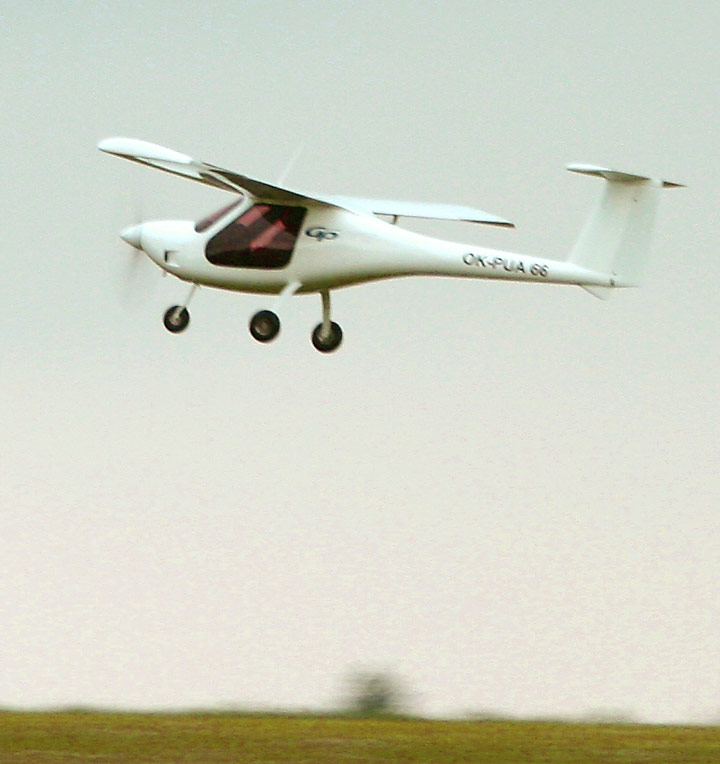
We got a sneak peak at the GP ONE, which is in development for the Euro market...with a possible LSA version in the future.
Scant details yet, but you can glean a sense of the airplane from the pdf here.  And look at those sculpted composite lines...impressive.
The GP ONE just had it's maiden flight on May 26 - congratulations to the company and its Sales Manager Miroslav Boubela, who affirms the carbon-fiber composite construction airplane will be offered in Europe in Sept. of this year for 52,000 Euro or $63,500.
That's an attractive number if they can pull it off: similarly-priced U.S. LSA like the Rans S-6ELS and X-Air are ultralight-style construction, whereas the GP ONE is all composite.
Skyleader also intends to market the airplane with a Rotax 912 UL 80 hp engine, Galaxy ballistic parachute, 3-blade ground adjustable prop, and other features as standard equipment.
Not sure how the company will meet such ambitious goals given production cost realities, but come September we'll be looking for more news of this beautiful new LSA.

   ---photos courtesy Skyleader

No Trouble In Paradise

Paradise Aircraft, based in Florida, joins the Facebook crowd with its own fan page here.  Chris Regis, U.S. rep for the Brazilian-based company which has certified the airplane in the United States, Brazil, Australia and South Africa, tells me the company is moving ahead after a good spring sales performance with some company and product updates.
On the Facebook page you'll find an a aerial view of the new 75,000 sq. ft. factory for producing the Paradise P1.  The design just celebrated its 10th anniversary at the end of 2009.
Carbon-fiber float maker Mead and Paradise have teamed up to offer amphibious floats for the P1.
The camping picture from owners Neil and Karen Salmi shows the "stuff" carrying ability of the P1.  Not a lot of LSA could carry that volume of gear.  Of course the total 1,320 lb. LSA weight limit still prevails, but that large "backseat" area is attracting buyers, as cargo is one of the consistent limitations among many models.
And check out the interior of the P1.
The U.S. model is essentially an LSA-legal version of a general aviation-certified aircraft, with the two rear seats removed as LSA can only carry two people total - but all that space remains!


   ---photos courtesy Paradise Aircraft and Neil and Karen Salmi

Thursday, June 10, 2010

Midwest School Gets First Skycatcher

Here’s a spot of welcome news for all those who've been waiting to get their hands on a Cessna 162 Skycatcher: Kansas Aviation, Inc. gets first honors for putting the long-delayed S-LSA into service for flight training and rentals.
An interesting note: the school is a wholly-owned subsidiary of Yingling Aircraft, Inc., one of three domestic sites Cessna picked to assemble and test fly the Skycatcher once it arrives from the Chinese factory where it’s fabricated.
The airplane was first delivered to a retail customer, Bravo Sierra Group, which leases the aircraft to Kansas Aviation for use in its Cessna Pilot Center (CPC).


Rental rate harkens back to the day when sub-$100/hr rental rates were common: the Skycatcher is available at $98 per hour wet.
Dave Tiday,
the school's manager and Chief Flight Instructor, believes the Skycatcher “will be key to developing the next generation of pilots.”
Powered by a Continental O-200D, 100-hp air-cooled engine with a fixed-pitch propeller, the Kansas Aviation C-162 has a Garmin G300 avionics system with a single, split-screen PFD (primary flight display) and an MFD (multi-function display).
The school will also offer a Light Sport Aircraft Transition Course to train certificated pilots in the differences between conventional GA single engine planes and the Skycatcher. 
Congratulations to Kansas Aviation!

Wednesday, June 9, 2010

Electricity In The Air!

All-electric airplane fans, this'll stand your hair on end!  Next month's 2010 EAA Airventure at Oshkosh, WI - easily the biggest air show in America every year - will feature activities focusing on the most exciting developments in electric flight all week long.
Visitors to the show will find display booths, daily forums and demonstration flights out on the flight line.  Can you say...Zap!?
And on July 30 there's a major event: Airventure's World Symposium on electric-powered flight.  The day-long discussion will cover all aspects on the future of electric aviation.
Check out who's on the panel of moderators of aviation industry leaders:
* legendary Scaled Composites founder Burt Rutan
*
Electric Aircraft Corporation founder and electric flight pioneer Randall Fishman (currently working on ElectraFlyer-X two-seat S-LSA
* Yuneec International founder Tian Yu (Yuneec made a sensation at Oshkosh '09 with its two-place E430 electric LSA),
* FAA Administrator Randy Babbitt
*
Sonex Aircraft founder John Monnett
* Earthstar Aircraft founder Mark Beierle, whose eGull ultralight displayed at AirVenture '09
* Erik Lindbergh, who launched an Electric Aircraft Prize through his Lindbergh Foundation at Sun 'n Fun this year.
There will also be forums every day at the Aviation Learning Center (like the Symposium, presented by GE Aviation Systems) on safety and airframes, motors, fuel cells, propulsion, advanced batteries and controls and regulations. 
Expect to see all-electric concept mockups, displays and flying prototypes.  Yippee!
To register for the free symposium or participate yourself in the forums or presentations, contact Kelly Meyer at EAA headquarters at kmeyer@eaa.org or 920-426-4800.
AirVenture runs from July 26 to Aug. 1 this year at Wittman field.
Be there or be reciprocating-spontaneous-combustion-powered square!
    --- photos courtesy ElectraFlyer and Sonex

Monday, June 7, 2010

So Cal Flyin'

For all you LSA California Dreamers out there, one of the oldest LSA schools in the southwest is worth a closer look.
San Diego Sport Flyers has been rolling the LSA dice for more than two years now and reports it has grown to 50 members and claims to get "several calls per day pertaining to the Sport Pilot license."
AOPA recently praised the LSA school for its "right stuff" - and that was an unsolicited rave.
The school just added a Legend Cub to the fleet and plans to bring on the Icon A5 once it's through testing and development too, sometime next year.
Already online are the Gobosh 700, SportCruiser and Sting Sport shown.
Tom Ellery, President of the operation, told editor Jessica Ambats recently that two high school students just got their Sport Pilot tickets and a 70 year old student will solo soon.
"I have to say," says Tom, "that we didn’t know what to expect when we first opened our doors, but it has been a great experience. We are working on putting a Remos plane in our local mall for Christmas."
The school operates out of Gillespie Field (KSEE) in El Cajon, CA.
Got a thriving LSA operation in your local area that you'd like to tell readers about?  Help me get the word out with a comment below or send me an email at lsa777jim@gmail.com.

Sunday, June 6, 2010

Phoenix Correction

Whoopsie.  In my last post on the Phoenix motorglider, I had some incorrect info that Jim Lee set me right on, so here's the skinny:
Urban Air USA which Jim represented and which imported and marketed the Lambada motorglider is being purchased, he sez,  "with plans to return the Samba XXL (composite low wing S-LSA) and Lambada (S-LSA motorglider) to production."
Jim also notes Phoenix Air S.R.O. and his Lee Aviation LLC, dba Phoenix Air USA, are completely different companies with no relationship to Urban Air.  
Also, I'd mentioned Evektor's new direct-sale program, but Mr. Lee also notes that Evektor is still working out the details and may not do direct sale ops but some other program instead.
I've got queries into the Czech company and will update once I hear.
Thanks for the clarifications Jim!

Friday, June 4, 2010

CT Hauls Ash

Here's a hot item that should shake the dust off the notion that LSA are little toy airplanes. (Sorry, couldn't resist.)
With all the concern recently over ash cloud emissions from Iceland's Eyjafajallawhatever volcano that disrupted global air transportation (and also revealed how precarious airline business models must if, as reported, they were in drastic financial jeopardy after only a few days of lost revenues), comes this fun and good news:
A specially equipped Flight Design CT Supralite has been called into duty to measure atmospheric volcanic dust levels. 
The Supralite is a version of the European CT line that is popular here as the CTLS.
Duesseldorf Technical University’s Department of Volcanology set up the ongoing study, including rigging the cabin with an oxygen system for higher altitude measurements.
The program includes monitoring sulfur and particulate concentration in levels from 1,000 to 14,000 feet. The objective is to create a clearer picture of the density and dispersal pattern of volcanic ash clouds.
The CT makes a great research aircraft because of its good climb (1,000 fpm) and high ceiling capability over 14,000 feet.  Add in the fast cruise, long legs, roomy cockpit for instrument monitoring equipment and the low cost of operation, and it's easy to see why the University chose the Supralite.
“As the CT series is a perfect survey aircraft,” said Flight Design's CEO Matthias Betsch (who was himself delayed returning to Germany from Sun ‘n Fun 2010 by the ash cloud, “Flight Design believes that more of its aircraft will be used for this kind of purpose.”
Just another example of how LSA are working their way into the mainstream by demonstrating utility.

Thursday, June 3, 2010

Phoenix Rising: The Next Big Thing?

Caught up with Jim Lee recently to find out what's up with the Phoenix motorglider I wrote about here a few weeks back.
The good news is his full time devotion to making Phoenix the Next Big Thing in LSA motorized soaring flight.  He's renamed his Urban Air company Phoenix Air USA.

Believe me, if you haven't tried a motorglider, you're missing one of aviation's greatest experiences.
Imagine cruising along as fast as 115 knots on a thermally active afternoon.  Up ahead, a big, white cumie cloud with a flat, gray bottom presents an irrestible invitation.
Here's where the fun starts: as you get closer, you turn off the engine, feather the prop, trim up for minimum sink, and start looking for the lift under the cloud.  In a minute or two your search is rewarded with a good, strong push under the left wing - That's lift calling your name!
You quickly bank the Phoenix left, the vario starts singing, and up you go toward cloud base.  Yee haw!

After an hour or so of working the lift and drifting downrange, you flip a couple switches, turn the key, and the Rotax 912 ULS hums to life and off you go.
For a real (not imaginary like this one) flight report, read Jim's right here.  He compares the Phoenix to the Lambada, which it essentially replaces as that airplane is no longer in production.

Jim seems to like everything about the Phoenix, including it's 15-meter span, excellent sink rate, and the economical long range cruise given its beautiful all-composite streamlined shape.

I'd hoped to fly the Phoenix at Sun 'n Fun last April because I fell in love with the Lambada.  But delivery to the U.S. was delayed.
Now, sez Jim, two are on the boat from Europe, with another coming soon after.
Even with current sluggish LSA sales numbers, there's little doubt this is one airplane to watch: if it's even a bit better than the Lambada I flew, as Jim claims, anybody with a hankering for motorized gliding flight will be smitten too.
BTW, Jim is no longer representing Evektor in the U.S. (more details on Evektor's direct marketing plans soon, as I receive requested details from the Czech headquarters.)

    ---photos courtesy Phoenix Air USA

Wednesday, May 26, 2010

Major LSA Project Shuts Down

I've had my head buried in pilot reports, image processing and P&P's 2010 LSA Buyer's Guide. Guides in particular never seem like they'll be such a mind-numbing chore yet every time the same number of eyeball-jittering, typing finger-stiffening days roll by. Look for it in the Oshkosh issue, late June I think.

There are 107 registered LSA models on the books.  I couldn't write about all of them so went with the top-selling 20, realizing even then some great airplanes get left out, so I factored in another couple dozen or so that stand a good chance of garnering market share in the future.
Most if not all The Magnificent 107 remain in some state of production - a minor miracle given our sluggish  economy.  Even more new designs approach ASTM certification this year.  Clearly it's going to be a big pie -- with a lot of small slices -- for a long time to come.
Given our "Little Industry That Can" bravura, it's always a lamentable duty to report whenever a noteworthy aviation project goes down the tubes.  But reality is reality:  the Sadler Vampire project is looking for another owner.
The original Vampire revved everybody up back in the early '80s as a unique, single seat ultralight.
Here's a summary from an excellent Wikipedia blurb:

The Vampire won Grand Champion Design at Oshkosh in 1982.   Bill Sadler started up American Microflight, which became Sadler Aircraft Co., and by 1984 was cranking out 4 units per month!  Not long after, ABC's 20/20 broadcast its infamous, recklessly distorted "expose" on the danger of ultralights that nearly killed the industry singlehandedly, or I should say underhandedly...a cautionary testament, more evident than ever in today's media, to the press's power to inflame irrational fear in the general public, whatever the truth might be.
Anyway, Sadler, facing the dramatic industry downturn everybody suffered after 20/20, sold the rights to Aero.V.Australia.
By the late '80s, Sadler developed a military version: the aptly-named Piranha, with enclosed cockpit, bullet-resistant Kevlar fuselage pod, machine gun mounts in the wing roots, all to support a ground attack, interdiction and counterinsurgency mission.  Holy Third World combat ops, Batman!
A UAV (unmanned) version was developed around the same time but never flew without a pilot.
David Littlejohn, VP of Sadler Aircraft, just informed me that once the principals looked at the books, they realized they'd have to sell 40 units just to break even on R&D expenses in their attempt to bring the Vampire to the S-LSA market.
In his own words (excerpted):
"...the economic downturn ...has taken its toll on the Vampire. I'm disappointed to report that the Vampire project is being suspended and offered for sale.
I apologize to all that have been following our progress. As is so often the case though, we had lots of "interested" folks, but not folks interested enough to commit...money in escrow and secure aircraft. As such, we failed to meet the required pipeline commitments needed to receive second-stage capital from our investors.  It's frustrating.  But such is reality in periods of economic uncertainty.
At this time we are seeking buyers of the company. Specifically, we have the prototype Vampire and various parts for three more Vampires already under construction. We are asking for $50,000 obo (development costs were more than 15 times [that] amount). And that price includes a nearly brand new Jabiru 3300 with under 100 hours on it.
At this time the company is being sold as a package including: prototype Vampire (has flown, but not flying now), wing sections for 4 aircraft (unskinnned), raw aluminum to skin the wings, spars and tail booms for 2 planes, landing gear for 4 planes, various other miscellaneous parts.
If interested...please send an email to: info@sadleraircraft.com.
The Vampire was an exciting original from day one...if it's resurrected yet again, maybe it should be renamed the Lazarus - this is one design that just won't die.
We sincerely wish everybody connected with Sadler Aircraft the best of good fortune going forward.

   ---images courtesy Sadler Aircraft

Tuesday, May 18, 2010

PiperSport Taps Into Social Media

If you've checked into Facebook since January you may know that PiperSport has its own page that you can become a fan of (I am, along with 9200 others so far!)
What you probably don't know is there's a fascinating video interview that chronicles why and how Piper decided to add social media such as Facebook and YouTube to its marketing strategy for the already-popular LSA.
Very very interesting, and likely a sign of future marketing efforts from ad-cash-starved LSA makers.
To date, the only other company I know that has a Facebook presence is Gobosh, and they've been there for some time.
I won't reprise the entire video clip (it's well worth watching), but here are some of the highlights:
Back in January, Piper's content creators were tasked with making a video for the imminent launch of the PiperSport (the rebadged, "Piperized" CZAW SportCruiser).  They also had to set up a Twitter feed, YouTube channel and the Facebook fan page.

And they had a week to do it in.

Greg Jarboe does a video interview for Search Engine Watch with Michael Kolowich of Boston's DigiNovations, who gives a thumbnail of the entire project.  Here's the vid - in case it's slow to load, go here:


Things that caught my ear from the video:
* The goal was to create a less formal market presence that would work on authenticity, including interviews with Piper notables including Piper's Chief Engineer and my longtime colleague Bart Jones, the company's Chief Pilot.
* Piper wanted a "live feel".
* It had to be up in time for the January launch date at Sebring.
* A PiperSport was sold online the very first week...and paid for with PayPal!
* the creators input key tag phrases to help web searchers find the site, including: light sport aircraft and the brand names of key competitors - very smart.
* The Facebook video was viewed more than 7000 times the first week.
* PiperSport's YouTube channel has more than 22,000 viewings for several of its videos.
A lot of marketing types would do well to watch Piper's venture into social media, especially if it proves a sales success.

Wednesday, May 12, 2010

FlewTube

Getting the word out to the great unwashed about the virtues of LSA flight - even with the inevitable "mainstream media" gaffes and general buffoonery it typically displays regarding general aviation - is an ongoing devotion for all LSA entrepreneurs, from manufacturers to flight schools.
Witness then this terrific video clip that enterprising young Brit (profiled here a few weeks ago) Charlie Thompson of Santa Monica Flyers pulled off on Los Angeles's local, venerable tv station, KTLA.


I remember KTLA and it's veteran newscasters from age 5 (that's six decades back, sports fans!)  The station has a long and storied history, so having it run a spot extolling the virtues of LSA during its prime broadcast slot and also posted on the web is a real plum for sure.
Charlie wisely told the reporter the aircraft he was flying was the PiperSport, although in fact he's training and doing demos in a CZAW SportCruiser.
There were the usual daffy phrases we've come to expect from "infotainment" news spots, such as "This airplane is singlehandedly changing the face of the flying community," and "Beat the hassle of airports!"
To be fair, the reporter did a reasonable job considering how badly the media usually does with aviation stories.
For instance, he accurately reported on the virtues of LSA, using automobile comparisons - what else from car-centric L.A.?:
  *  low-fuel burn: "at 40 miles per gallon, it beats every car in mileage except the Prius!"
   * aircraft price: "It costs the same as a high-end Porsche!"
    * and fuel burn again: "You can fly yourself to Las Vegas for only $45!"
Ah, how I miss the Land of Lah.
But image is everything, likewise positive stories - any positive stories - about general aviation.
So even though we LSAers know that SportCruiser (which the tele reporter happily dubbed "PiperSport Cruiser") is essentially the same airplane as the PiperSport, I still say "Well done, Charlie Thomson!"

Tuesday, May 11, 2010

The Longest Flight

Two wild-and-crazy Swiss airline pilots decided to take a busman's holiday - one hell of a busman's holiday - by taking two Flight Design CTLS S-LSA on a little jaunt, in celebration of the birth of aviation in Switzerland 100 years ago.
Their destination?  The airport they launched from April 30th: Sion, Switzerland.
The catch?  Before they return to Sion, they're flying around the world!
Dan Johnson's got a detailed writeup on his Splog but the short tell is the pilots, Yannick Bovier and Francisco Agullo, will fly 27,500 miles over 18 countries, five continents and two oceans. 
Both craft are modified to carry extra fuel - 120 gallons each, instead of the stock 35 gallons. 
They're also carrying survival gear including water ditching rafts as their route crosses both the Atlantic (Africa to South America) and the Pacific (America to Viet Nam).
As of today they've made it across from Africa to Natal, Brazil.
Keep track of their progress and get the in-depth story on their website.
Bon Voyage Francisco and Yannick!

Wednesday, May 5, 2010

ICONographic Marketing

I thought I'd share a couple interesting videos recently posted on the Icon Aircraft website.  There's a multimedia gallery of high-profile, appealing eye candy, including YouTube videos chronicling various aspects of the ongoing test program for the company's A5 amphibian S-LSA.
Two I found particularly interesting: a stall sequence and a potpourri of recent flight test ops.
First, the stall sequence shows the classic tufted airflow indicators taped to the wing to demonstrate inflight stall progression from the root outward.
Watch the tufts near the root begin to wiggle and change direction first, demonstrating loss of lift.  Then see the stall move outward from the root and along the trailing edge.  To my eye, it seems like the middle of the wing completely stalls before the root.  I'd like to know about the aerodynamic significance of that, and why the wing doesn't stall more classically at the root first.
Also notice how the flaps appear to be taped at the inboard seam, which would seem to prevent deployment from 0 degrees.
Whatever it all means, it's fascinating to watch aerodynamic design theory demonstrated so dramatically!


The other video is a series of short in-flight clips of water/land-launching capabilities, water taxiing versatility and in-flight maneuvers, both from a photo plane and from the ground.


I watched the Icon go through its paces at the Oshkosh Seaplane Base last summer (along with hundreds of other folks) and was particularly impressed with the nimble, smooth handling and sexy inflight look of the amphib.
In sync with the company's marketing approach for the Icon - "Jetski For The Sky!" - the flight video shows a couple (wingless) jetskis in formation on the water with the A5.  Very cool, very smart - but nothing this company has done so far seems remotely second class.

Case in point: Demonstrating how well-connected, sophisticated and well-funded this company's principals are, an Icon mockup is on display at John F. Kennedy Airport in NYC to celebrate Jet Blue Airline's 10th anniversary!
Icon continues to refine the bird toward ever-more-benign (translate: fun and safe for new pilots) handling that should greatly aid its push to attract watersport/non-pilot types to its market segment.
High speed water taxi testing continues along with ocean operations, such as challenging entry/exit tests near Long Beach, CA.
Everything seems on track to deliver the bird by 3rd Quarter 2011...hey, that's next year!  Can't wait for a demo myself.  Maybe I can get my LSA water rating in an Icon: wouldn't that be a trip?

   ---photo and videos courtesy Icon Aircraft

Monday, May 3, 2010

Sympathy Flying

Michael Combs's epic Flight For The Human Spirit odyssey just made it into Chicago a few hours ago after a whirlwind tour of the Northeast (he just missed some premature, summery 90-degree weather - and nasty thunderstorms).
Since Michael's flying a new Remos GX, I thought to make a sympatico gesture by taking the air in the same type, and, I confess, to prep my flight report for the July print issue of P&P.
BTW, Tom Peghiny, Prez of Flight Design, told me recently he was in the dark whenever I wrote "dead tree P&P".  (I guess he doesn't read Time magazine online, they say "dead tree Time" all the, uh, time.)  Alas, in deference to Tom and others similarly not conversant in super-hip online lingo, I must abandon journalistic trendiness in favor of humdrum journalistic clarity.)
Anyway, with many thanks to Ron Glazer of Remos (and Marketing Veep Ken Weaver, who sent him up) for making an extra leg to meet me, I finally got my chance to fly the bird. 
Ron flew the 2010 Remos GX Aviator II (full panel version) into Great Barrington Airport (GBR) in Massachusetts - one of God's little aviation secrets, shhh!
Ron, a recent grad of Embry Riddle who's already racked up 435 hours in the GX (!), showed me the ropes and confirmed what I'd long suspected from anecdotal reports: all that high-profile presence and aggressive marketing from Remos is backed up by a first-class S-LSA.
Of course, you'll want to read my full report in the mag, but here's a brief kiss-and-tell:
> wonderfully light, smooth handling in all axes
> very comfortable and stable in flight
> really well-thought out panel placement of knobs, breakers, etc.
> ground handling with the steerable nose and console brake is like driving around a go-cart...very precise, very easy
Meanwhile, I am grooving psychically with Michael Combs on his flight because I know he's got a terrific LSA to carry forth his crusade...just wish I was with him!

Thursday, April 29, 2010

New Purpose-built LSA

Another LSA (and another from Czech Republic!) is about to land on our shores.  It'll be featured in my Cool Stuff overview story in the June issue of P&P, but here's a sneak preview of the cute little low wing, and why I think it could be a winner for potential owners.
It's called Corbi Air Alto 100.
Two veterans of the sport aircraft biz - Dan Coffey and Ron Corbi - have extensive backgrounds in sport aircraft maintenance and marketing.  They saw through direct experience that many LSA had weak points that came out after extensive use in the field: insufficiently sturdy nosegear, cheap foreign tires (that were also a problem to reorder quickly).
So they went to an established Czech manufacturer (Direct Fly) and asked them if they'd be willing to update their four-year-popular Euro bird with American components for ASTM-certification as an S-LSA for the states. 
Coffey’s and Corbi’s approach might be called “pre-emptive” maintenance -  they intend to design out the very things that tend to fail in LSA. 
“Our focus with the Alto is to enhance the ‘maintainability’ of the airplane,” Coffey told me in a lengthy chat at Sun 'n Fun.
“We’ve added things like American-made Matco wheels and brakes, bucked rivets to replace pop rivets in high-stress areas, Vertical Power’s electronic electrical system, and the Approach Hub avionics wiring system for plug-and-play component upgrades.”
Another good idea here is to have as many quickly available U.S.- made parts as possible to make sure no flight school or owner is ever down for long.
Another feature: Alto’s canopy slides forward for easy access to the back of the panel.
Look for the cute Globe Swift-like Alto to be ASTM-approved and shipping by year’s end.
And get this price: $99,995, which includes a Dynon Skyview EFIS!

Friday, April 23, 2010

LSA Fighter Zoomin'

I had the distinct pleasure of closing out my 8 day stay in Florida for Sun 'n Fun's airshow with a visit to the MySky company at the fabulous Spruce Creek aviation community near Daytona, FL.
My host was Prez Dieter Canje, who along with company principal and 30,000 hour pilot Tim Plunket, introduced me to the airplane.
We were all set to shoot air2air and ground photography but Ma Nature had other ideas with some rain and overcast skies.
I did the next best thing and copped a ride with Tim in the MS-1 prototype.
And boy, am I glad I did.  Or dude, am I glad I did.  Whatever.

First off, I have to say this was the best demo I've ever had, and here's why: Tim spent a good ten minutes briefing me on the flight deck, controls, knobs and levers I'd be a-twiddlin'.  Then he talked me through the maneuvers we'd be doing.
"I'll do everything first, then you'll do it," he instructed, and that's exactly what we did: stalls, high bank turns, big looping wingovers, high speed dives.
"Remember," Tim said at one point near the end of our flight, "there's no rule against going faster than 120 Knots in an LSA other than straight and level, full power."  This, while we dove for the deck at 140 knots plus, smooth and solid and not unlike, (I gotta say because I've had the pleasure), zooming down in a P-51 Mustang or Extra 300.  The feel, the narrow tandem cockpit, the fuselage right-side fighter-like control stick, the bubble canopy - oh yeah, you can see where this project is going.

I felt the urge to bark "Tally ho!  Bogies at 5 o'clock low, arm your guns!" -- because this is definitely a Top Gun experience compared to most other LSA.
The company hopes to have the airplane in delivery by the end of the year.  Prototype #2 is being built in their hangar at Spruce Creek and more refinements will be made.
But that flight with Tim stands in mind as the most thoroughly enjoyable and illuminating 24 or so minutes I've spent in an LSA yet.
Stay tuned: Dan Johnson will be writing a flight report on it for Plane & Pilot down the road.

Tuesday, April 20, 2010

Lost In Alligator Land

Kids, don't try this at home...or in the air.  Well, unless you leave yourself no other choice.

Whilst flying a new LSA on the day after the Sun 'n Fun airshow, my demo host and I were enjoying the puffy cloud kingdom somewhere not too far from Lakeland Linder Field in central Florida when the Garmin G3 center display went black.
No amount of coaxing, button pushing, or breaker recycling would bring it back.  We chalked it up to a new installation and the fact we'd sat on the ground for 45 minutes in the heat, in a ridiculously long line of departing airplanes - and a methodically sloooooow tower controller determined to go by the book while 30 airplanes sat watching their engine temps rise...and rise.  This guy could learn a thing or two from the boys at Oshkosh about expediting departures.
Anyway, here we were a few minutes later, tooling around the countryside, not overly concerned about losing the one display, when bip!, the other G3 display coughs, hiccups, and goes down too.
Sympathy pains maybe but Holy Hannah, whatta we do now?
"Fortunately," said my right seat companion with a confident smile, he being an ex-Air Force jet jockey, "I've got a GPS along as a backup."
I breathed a sigh of relief as he rummaged around in the baggage compartment behind the seats.
"Hmmm," he said, (and did I detect a twinge of embarrassment?), "I don't seem to have the GPS.  I must have left it on the ground."
"Well, no problem," he continued with strained joviality.  "I've got a sectional...now where is that sectional?"
Several minutes later, after the sectional proved to be irretrievably buried somewhere in all the gear, we both scanned the green farmland, swamps and sand mines or whatever those big square water-filled dirt lakes are and realized we were completely and utterly lost.
I opined we were west of Lakeland.  He thought we were south.
One thing I'd never noticed: It's amazing how much one area of central Florida looks remarkably like many other parts of Central Florida.
All ended well: I whipped out my Swiss Army Knife of electronic devices -- the ubiquitous iPhone that never leaves my side unless I forget it -- tapped the GPS ap icon, and lo and behold, we had enough of a signal from below to show us right where we were...which turned out to be a little west and 20 miles south of Lakeland. 
Ah yes...love my little iPhone.